

How to validate a SaaS idea in a weekend with AI (before you waste three months building)
42% of startups die from building something nobody wanted. Here's a concrete, hour-by-hour weekend plan — using AI for speed and real people for the truth — to find out before you write a line of code.
- The number-one reason startups fail is 'no market need' — around 42% of them, per CB Insights. It's a demand problem, and no amount of good code fixes it after the fact.
- You can meaningfully test an idea in a single weekend: sharpen it to one sentence, pressure-test it with AI, talk to five real people, and put up a fake-door landing page.
- Use AI to move fast on research, competitor scans and landing-page copy — but verify everything it tells you, because it invents competitors and numbers with total confidence.
- The only signal that counts is a stranger giving you something scarce — their email, their time, or a small deposit. Friends saying 'great idea' is noise.
- A useful bar: 10+ genuine sign-ups from ~100 relevant visitors. Hit it and build a tiny MVP. Miss it and you just saved three months and a lot of money.
The most expensive mistake in software is building something nobody wanted. I've watched brilliant, hard-working people spend three months and a large chunk of their savings on a SaaS product, launch it, and hear nothing but silence. The code was clean. The design was nice. The idea was never tested against a single real human before the building began.
This isn't rare bad luck. It's the single most common way startups die. When CB Insights analysed hundreds of startup post-mortems, the top reason companies failed wasn't bad tech or weak founders — it was "no market need," at around 42%. Add "ran out of cash" (about 29%) and you've explained roughly seven in ten shutdowns — and cash exhaustion is usually just the slow-motion symptom of building something the market didn't want. In the current wave, it's getting sharper: of the thousands of AI-driven SaaS startups launched in the recent gen-AI rush, a large share are already expected to fold within two years, most for the same old reason dressed in new technology.
Here's the good news buried in that grim data: the thing that kills most startups is also the cheapest thing to test. You can meaningfully validate a SaaS idea in a single weekend now. AI makes the fast parts genuinely fast, and real people give you the truth AI never can. This is the exact plan I'd follow, hour by hour.
Why validation beats building — every single time
A SaaS product almost always dies for one reason: not enough people had the problem badly enough to pay to solve it. You cannot fix that with better code, a nicer UI, or more features later. If the demand isn't there, you're pouring effort into a bucket with no bottom.
So the smartest, highest-return work you can do is find out before you build — when changing direction costs a weekend instead of a quarter. Validation is not about proving you're right. It's the opposite: it's trying hard to prove yourself wrong, cheaply, and seeing whether the idea survives the attempt. An idea that survives a genuine effort to kill it is worth building. One that only survives because you never really tested it is a time bomb.
There's a mindset shift here that separates founders who make it from founders who burn out. Building feels like progress — you can see the code pile up. Validation feels like risk — you might hear a no. But a no on a landing page is a gift; a no after launch is a funeral. Learn to want the cheap no.
The weekend plan, hour by hour
Block out two days and protect them. Here's the shape.
Saturday morning: sharpen the idea to one sentence
Write your idea as a single, specific sentence in this exact form:
"I help [a specific person] solve [a specific painful problem] so they can [a clear outcome]."
If you can't fill those blanks precisely, that's your first finding, for free. "A tool for small businesses" is not an idea — it's a fog. "I help freelance designers in India chase unpaid client invoices so they get paid on time without awkward WhatsApp reminders" is an idea. It names a person, a real pain, and a clear win.
The tighter this sentence, the easier every step after it becomes — who to talk to, what to ask, what to put on the page. Spend a full hour here. Rewrite it five times. Vague ideas produce vague validation, which produces false confidence, which is the most dangerous outcome of all.
Saturday midday: pressure-test with AI (and fact-check every word)
Now open your AI tool of choice and use it as a sparring partner whose job is to attack your idea, not flatter it. Prompts that work:
- "Here's my idea: [sentence]. Give me the three strongest reasons it will fail."
- "Who already solves this problem, and how do they do it today — including clumsy workarounds like spreadsheets and WhatsApp?"
- "What would make someone keep using their current duct-tape solution instead of paying for mine?"
- "What's the smallest version of this that would still be genuinely useful?"
This is where AI earns its place: it surfaces angles, competitors and objections in minutes that would take you hours to find. But treat every factual claim it makes as a lead to verify, never a fact to trust. AI will confidently name competitors that don't exist, quote market-size numbers it invented, and reassure you the market is "growing rapidly" with zero basis. Open the links. Check the names actually exist. Use AI for speed and breadth; use your own eyes for truth. A founder who believes AI's made-up market research has simply automated their own delusion.
Saturday afternoon: talk to five real people
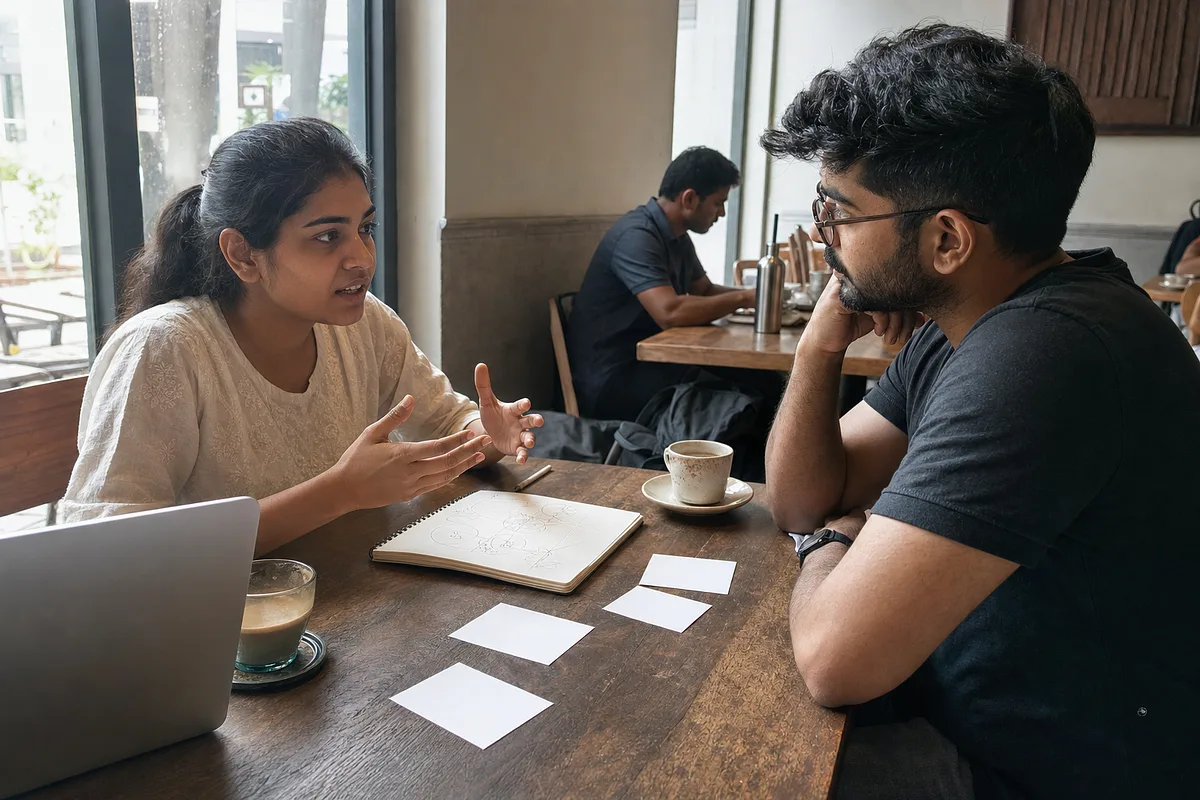
This is the step everyone skips, and it's the most important one in the entire plan. Find five people who genuinely fit your "specific person" and talk to each for fifteen minutes. A WhatsApp call, a coffee, a Zoom — however you can get them.
The golden rule: do not pitch. The moment you describe your idea, they become polite, and polite people lie to spare your feelings. Instead, ask about their actual world, in the past tense:
- "Walk me through the last time you dealt with [the problem]."
- "What did you do about it? What did that cost you — in time, money, or stress?"
- "Have you looked for a better way? What did you try? Why did you stop?"
- "How often does this happen?"
Then go quiet and let them talk. You're hunting for one thing: the same specific pain, described in their own unprompted words, coming up again and again. If you find yourself having to explain why the problem is a problem, it probably isn't one worth building a business on. Real pain doesn't need to be argued for — people light up because you finally named something that's been bothering them.
Take notes on their exact phrases. Those phrases become your landing-page headline, because the best marketing is your customer's own words reflected back at them.
The goal of these conversations is not to hear "great idea." It's to hear an honest, specific story about a real problem — ideally an expensive one they've already tried and failed to solve another way. Praise is polite noise. Stories are data. Learn to tell them apart.
Sunday morning: build a fake-door landing page
Now put up a single, simple web page that describes your product as if it already exists, with exactly one clear action: "Get early access" or "Join the waitlist." AI can write the whole page — headline (use your customers' words from Saturday), the problem, what it does, who it's for, and the button — in under an hour. Modern AI website builders will design and publish it for you in the same sitting.
You do not need the product. You need to find out whether people want it enough to raise their hand. This is called a "fake-door" test, and it's one of the highest-signal, lowest-cost tools in a founder's kit.
One line on ethics, because it matters: keep it honest. You're genuinely collecting interest for something you're seriously planning to build — that's fair and normal. What you must not do is take anyone's money for a product you have no intention of building. A waitlist is honest. A checkout for vapour is not.
Sunday afternoon: send 100 real people to it
A landing page with no visitors tells you precisely nothing. Get 50–100 relevant people — your "specific person," not random friends — to actually see it. Practical ways to do that in an afternoon:
- Post in communities where your person already gathers: relevant subreddits, niche WhatsApp and Telegram groups, industry Slack/Discord servers, LinkedIn groups.
- Message the people you interviewed on Saturday and ask them to share it with one person who has the same problem.
- Post it on your own social with a genuine "I'm building this — is it just me who has this problem?"
- If you have a little budget, run a tiny, tightly-targeted ad for ₹500–₹2,000 aimed squarely at your person.
Then watch what real strangers do, not what friends say.
Reading the result: signal versus noise
Ignore the vanity numbers — views, likes, "looks cool in the comments." The only signal that matters is a stranger taking a costly action: handing over their email for early access, booking a call, or putting down a small deposit. Costly actions reveal real intent; cheap applause reveals nothing.
Here's a rough scoring rubric I use:
| What you see | What it means | What to do |
|---|---|---|
| 10+ sign-ups from ~100 relevant visitors | Real, testable demand | Build a small MVP for these exact people |
| 3–9 sign-ups | A flicker — something's there but the aim is off | Tweak the person or the promise, test again |
| 0–2 sign-ups from 100 | The market just said no, clearly | Change the idea, not the landing page colours |
| Lots of views, near-zero sign-ups | A clear "no" wearing an "almost" costume | Believe the sign-ups, not the traffic |
That last row catches a lot of founders. A thousand views and two sign-ups is not "so close" — it's the market telling you, loudly, that it doesn't care. Believe the action, not the attention.
The traps that fool smart people
- Friends being kind. People who love you will call your idea brilliant. Their approval is emotional support, not validation. Strangers who don't care about your feelings are your real test.
- Leading questions. "Wouldn't it be great if there was a tool that…" always gets a yes, and the yes is worthless. Ask about the past and the real cost, never the hypothetical future.
- Building because it's more fun. Writing code feels like control; talking to strangers feels like exposure. If you skip validation because you'd simply rather build, be honest that you're choosing comfort over the truth — and that comfort is exactly what the 42% chose too.
- Believing AI's research. Automated confidence is still just confidence. Every number AI gives you is a hypothesis to check, not a fact to bank on.
- Testing the idea on the wrong person. Often the problem is real but you aimed it at someone who doesn't feel it sharply enough to pay. Before you kill an idea, try it on a different, more desperate customer.
The tools I'd actually reach for
You don't need a fancy stack for this. A general AI assistant (Claude, ChatGPT or similar) handles the pressure-testing, competitor scan and copywriting. Any AI website builder — Framer, Wix, Hostinger, Durable — spins up the fake-door page in under an hour. A free form or waitlist tool captures the emails. A basic analytics view or even the builder's own dashboard tells you how many people visited versus signed up. That's the whole kit, and most of it is free or a few hundred rupees. The constraint on a good validation weekend is never the tools — it's your willingness to ask real people real questions and believe the answer.
A worked example, start to finish
Let me walk one idea through the whole weekend so it's concrete.
Say you're a freelance designer, and you're sick of chasing clients for unpaid invoices. Your idea: a tool that automatically sends polite, escalating payment reminders so freelancers get paid without the awkward WhatsApp nudges.
Saturday morning, you sharpen the sentence: "I help freelance designers in India chase unpaid invoices so they get paid on time without awkward reminders." Specific person, real pain, clear outcome. Good.
Saturday midday, you ask AI for the three strongest reasons it'll fail. It comes back with sharp ones: most freelancers use accounting tools that already send reminders; the truly painful non-payers ignore automated nudges anyway; freelancers are famously reluctant to pay for tools. It also names three "competitors" — you check, and one doesn't actually exist. Noted: useful angles, but verify everything.
Saturday afternoon, you talk to five freelance designers. Four of them light up at the topic — clearly a real, recurring, stressful problem. But listening closely, you hear something you didn't expect: the reminders aren't their real pain. Their real pain is the awkwardness and the relationship damage of chasing a client they want to work with again. Two of them literally say "I'd rather just eat the loss than nag a good client." That's gold — the problem is emotional, not administrative.
Sunday morning, you use that. Your landing page headline isn't "Automated invoice reminders." It's "Get paid without ever nagging a client again" — their words, their pain. AI drafts the page; you publish it in forty minutes with a "Join the waitlist" button.
Sunday afternoon, you share it in two freelance communities and message your five interviewees. By evening, 90 relevant people have visited and 14 have joined the waitlist — several adding notes like "please build this." That clears the bar. More importantly, the notes tell you what to build: the winning angle is tone and relationship-saving, not automation for its own sake.
Notice what happened. The idea survived, but it changed shape over the weekend — from "reminder automation" to "getting paid without damaging relationships." If you'd skipped straight to building, you'd have built the boring version nobody's excited about. Two days of validation didn't just tell you whether to build; it told you what to build. That's the real payoff.
After the weekend: what a "yes" and a "no" actually mean
If the weekend says yes, then — and only then — build a small MVP. Not the two-year dream; the single core thing your future customers signed up for, and nothing else. Get it into the hands of those first sign-ups within weeks, watch how they use it, and let their behaviour tell you what to build next. The waitlist you just built isn't a vanity metric — it's your first cohort of users, waiting.
If the weekend says no, you've just dodged the most expensive, most common mistake in software. Change the person or the problem — usually the problem is real but pointed at the wrong customer — and run the two-day loop again. That loop of test, learn, adjust is not a step before the real work of building a startup. It is the real work. The founders who win aren't the ones with the best first idea; they're the ones who run this loop the fastest and lie to themselves the least.
You genuinely don't need to write a single line of code to know whether your idea has legs. You need a sharp sentence, five honest conversations, a simple page, and a hundred real visitors. Two days. If the idea survives that, it's worth building properly — and that is the moment when getting your MVP built quickly and well starts to matter, because now you're building something you already know people want.
Frequently asked questions
Do I really need to validate before building? I already know it's a good idea.
Everyone who ever built something nobody wanted also knew it was a good idea. Validation isn't about doubting yourself — it's about testing the one assumption that kills most startups: that enough people have this problem badly enough to pay to solve it. If you're right, validation costs you a weekend and gives you conviction. If you're wrong, it saves you months. There's no version where skipping it is smart.
How many people do I actually need to talk to?
Five focused conversations in a weekend will teach you more than a hundred survey responses, because you can follow up, watch their face, and hear the problem in their own words. You're listening for the same specific pain coming up again and again. If it takes real effort to convince someone the problem is even a problem, that's your answer.
Can AI just validate the idea for me?
No — and this is the most important line in the whole plan. AI is superb for speeding up research, scanning competitors, and writing your landing page in minutes. But it cannot tell you whether real people will pay, because it has never met your customer. And it will confidently invent competitors that don't exist and market sizes it made up. Use AI for speed; use real humans for truth; fact-check every claim AI hands you.
What exactly counts as 'validated'?
Two things together. First, a clear, repeated, specific problem in your conversations — the same pain, described unprompted, more than once. Second, real strangers taking a costly action: joining a waitlist, giving an email for early access, booking a call, or leaving a small deposit. A rough target is 10 or more genuine sign-ups from about 100 relevant visitors. Views, likes and 'looks cool' don't count.
What if the weekend says no?
Then it's the best-value 'no' you'll ever get. You spent two days instead of three months and a chunk of savings discovering the idea needed to change. Adjust the audience or the problem — often the problem is real but you aimed it at the wrong person — and run the weekend again. That loop, not the first idea, is the actual skill of building products.
Want it built for you?
We design, build and ship your app to the App Store & Play Store — done for you, at a fixed price from ₹9,999.
See app-building plansLive BatchWant to learn to build it yourself?
Learn to plan, build, test and ship real business apps in four weeks of live classes — no coding needed.
Explore the Live Batch